GuideAll 16 personalities, trait sliders, and island planning
Tomodachi Life: Living the Dream Personality Chart Guide
Find all 16 personality types, compare the four groups, and use slider notes to build a more varied Mii cast without treating the chart as a forced relationship calculator.
How many types are there?
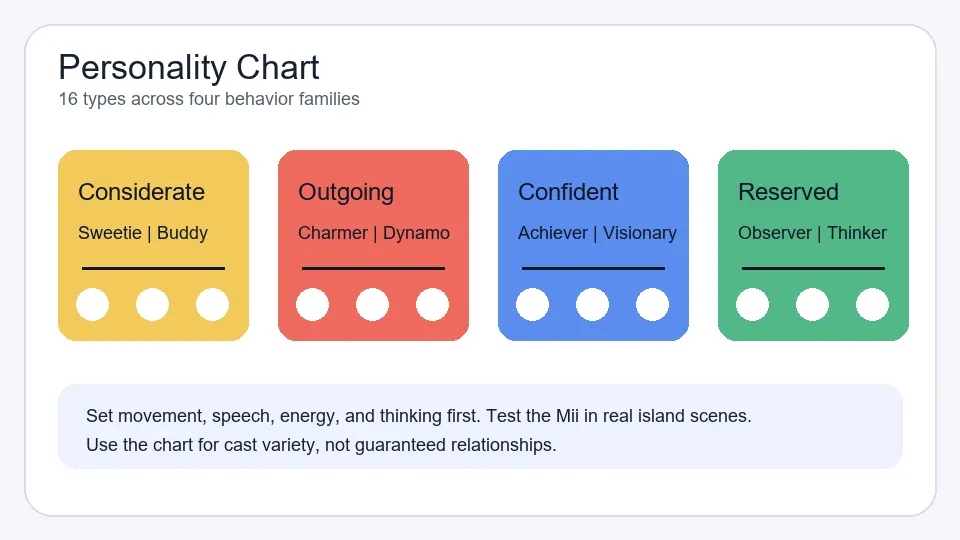
Living the Dream uses 16 personality types arranged across four broad groups. The names can differ by region, but the chart logic is the same.
Which sliders matter?
Movement, speech, energy, and thinking shape the result most clearly. Overall can change the feel of a profile, but guides often treat it separately from the core chart result.
Can you change it later?
Yes. Edit a Mii when their behavior feels wrong, but make small changes and watch a few days of island events before changing the chart again.
How the Personality Chart Works
The Tomodachi Life: Living the Dream personality chart is one of the most important choices you make when building a resident. It does not simply label a Mii as cheerful, quiet, serious, or dramatic. It gives the island a behavior profile to draw from when that resident talks, reacts to gifts, visits other homes, starts conflicts, asks for advice, or becomes part of a bigger relationship story. That is why two Miis with similar faces can feel very different after a few daily check-ins.
Most player-facing guides describe the chart through five profile sliders: movement, speech, energy, thinking, and overall. The first four are the clearest inputs for reaching a type. Overall is still useful for role-playing because it changes the feel of the profile screen, but it is not the best lever when you are trying to land a specific personality family. If the result is close but not exact, adjust one slider at a time and save notes instead of moving every setting at once.
The safest way to use the chart is to start from the character idea, then confirm the in-game result. A shy bookish Mii might belong in a reserved type, but a quiet romantic may fit a considerate type better. A loud friend can be outgoing, but a loud planner may be closer to confident. Treat the chart as a casting tool for island drama, not as a personality test that must describe a real person perfectly.
1
Pick the story role first
Decide whether the Mii should be the helper, instigator, dreamer, leader, observer, or wildcard on your island.
2
Set the four core sliders
Change movement, speech, energy, and thinking toward that role. Avoid changing every value repeatedly after one surprising event.
3
Watch the island for several sessions
Personality shows through repeated behavior. Judge the result after conversations, friendships, fights, and problem bubbles.
All 16 Personality Types and Regional Names
Living the Dream keeps the chart easy to scan by grouping the 16 types into four broad families. Regional naming can differ, so a US guide and a UK or PAL guide may describe the same underlying personality with different labels. That is why this page lists both common name sets when a pair is widely used. The important thing is the behavior pattern: how direct, active, patient, sensitive, spontaneous, or analytical the Mii tends to feel in play.
Do not overread one label. A Sweetie or Softie does not guarantee perfect kindness in every scene, and a Maverick or Individualist is not automatically difficult. The game still mixes mood, current relationships, problem bubbles, and event timing. The chart gives your island a better cast balance so every resident does not react the same way to food, rooms, friendship prompts, and daily surprises.
Group
US names
UK/PAL names often seen
Best use on an island
Considerate / Easy-going
Sweetie, Cheerleader, Buddy, Daydreamer
Softie, Optimist, Carer, Dreamer
Warm friends, romantic storylines, gentle mediators, and residents who make the island feel less chaotic.
Outgoing / Energetic
Charmer, Dynamo, Go-Getter, Merrymaker
Charmer, Hot-Blooded, Adventurer, Bubbly
Social starters, joke-heavy residents, party energy, and Miis who keep scenes moving.
Confident / Ambitious
Achiever, Maverick, Rogue, Visionary
Busy Bee, Individualist, Individualist, Leader
Driven characters, rivals, creators, island leaders, and residents who feel decisive or unusual.
Reserved
Observer, Perfectionist, Thinker, Strategist
Introvert, Perfectionist, Thinker, Patient
Quiet observers, planners, careful friends, and Miis who add contrast to louder personalities.
How to Choose Personalities for a Better Island Cast
The best islands usually mix personality groups. If every Mii is outgoing, the island can feel noisy but shallow. If every Mii is reserved, the daily loop may feel slower and less reactive. A balanced starting cast gives the simulation more material: one warm mediator, one dramatic social starter, one careful observer, one ambitious planner, and a few characters who do not neatly fit their appearance.
For real friends and family, avoid treating the chart as a judgment. Choose a version that makes play fun and recognizable without turning a real person into a joke. For fictional characters, decide whether you want accuracy or comedy. A heroic character can be a Visionary, but making them a Daydreamer or Merrymaker may create funnier scenes. For original characters, build contrast on purpose: a tiny Mii with a bold confident profile or a flashy performer with a surprisingly reserved profile can make the island more memorable.
If you are preparing Miis to share locally, write down the personality group, sliders, voice style, pronouns, catchphrase, and any important visual details. A screenshot alone can miss the settings that make the Mii behave correctly after your friend rebuilds them.
Island goal
Useful mix
Why it works
Drama and romance
Considerate plus outgoing plus one confident rival
Creates affection, confession prompts, and conflict without making every scene aggressive.
Comedy clips
Outgoing residents with reserved straight-faced friends
The contrast makes jokes, awkward visits, and Mii News moments read better.
Family or friend island
Mostly recognizable types with one or two wildcard choices
Keeps the cast familiar while still letting the game surprise you.
Long-term diary play
All four groups represented from the first week
Prevents the island from becoming one-note after the first few sessions.
What Personality Affects in Relationships and Daily Behavior
Personality does not let you force two Miis to become best friends, confess, marry, or move in together. It affects the tone of the resident and can influence how their scenes feel, but the relationship system still depends on timing, mood, existing connections, advice prompts, and random events. A considerate Mii may feel like a natural helper, and an outgoing Mii may appear more socially active, yet either can still argue, reject a confession, or surprise you.
Use personality alongside routine care. Feed Miis, solve problem bubbles, visit homes, calm fights, and answer advice prompts consistently. If you want a couple to work, personality can make the pairing feel believable, but the stronger practical habit is to keep both residents happy and responsive. For friendship-focused islands, use compatible and contrasting personalities: two warm Miis may become cozy friends, while a confident Mii and a reserved Mii can create a fun mentor or rival rhythm.
When a Mii behaves in a way that seems wrong, do not immediately remake them. One scene is not proof that the chart failed. Watch a few different event types: food reactions, home visits, Mii News, conflicts, friendship prompts, and gift requests. If the pattern still feels off, make a small slider change and test again.
Slider Checklist: Reaching a Type Without Overcorrecting
The personality chart is not a hidden MBTI test. It is a practical way to turn movement, speech, expressiveness, attitude, and overall energy into one of 16 island behavior profiles. Search results often mix US names, UK/PAL names, older 3DS labels, and fan shorthand, so use the chart behavior first and the label second.
When a Mii lands near the wrong type, change one slider at a time and retest after a few scenes. Movement and speech usually change the visible pace first; expressiveness and attitude change how scenes feel; overall energy can push a resident toward a more active or more reserved family. Keep notes for shared Miis so another player can rebuild the same personality instead of guessing from a screenshot.
Slider area
What it changes
Adjustment tip
Movement
How active, quick, or calm the Mii feels in scenes.
Move gradually when a resident feels too sleepy or too restless.
Speech
How direct, chatty, or quiet the Mii reads.
Use it to separate loud performers from thoughtful observers.
Expressiveness
How strongly reactions and moods appear.
Raise for comedic characters; lower for deadpan or reserved roles.
Attitude
How careful, confident, or spontaneous choices feel.
Adjust when the role feels too cautious or too pushy.
Overall energy
Which personality family the final type leans toward.
Use small changes after the four core sliders are close.
Personality Chart Search Guide: Types, Compatibility, and Sliders
Use this Tomodachi Life personality chart as a lookup for all 16 types, then use the slider notes to recreate the result in the editor. The common searches Tomodachi Life personalities, Mii personality chart, and personality guide describe the same informational task: identify the type, understand how it feels in play, and choose a cast that is not one-note.
Compatibility is a planning question, not a guaranteed calculator result. Personality can create contrast and believable scenes, but it does not force friendship, romance, or marriage. This page answers all-personality and compatibility questions inside the existing chart guide; a separate personality calculator would be a different tool intent and is not part of this page.
A mixed cast makes personality choices easier to compare over several island sessions.
Candidate keyword
Difficulty
Page fit
Decision
Tomodachi Life personality chart
Similarweb global difficulty 1
Exact chart intent
Keep as primary in metadata, H1 context, first answer, and table.
Tomodachi Life personalities
Global difficulty 1
Very close informational intent
Use in body copy and the FAQ answer.
Mii personality chart
Global difficulty 1
Close supporting intent
Use in the 16-type table and related anchor.
Tomodachi Life personality guide
Global difficulty 1
Guide variant
Use in the intro and FAQ, not a separate URL.
What are all the personalities in Tomodachi Life?
Global difficulty 1; question tab
Direct question
Answer with the 16 types and four families in the FAQ.
What personalities are compatible in Tomodachi Life: Living the Dream?
Global difficulty 1; question tab
Compatibility support
Answer with mixed-cast guidance and limits on forced outcomes.
Personality calculator
Distinct tool intent
Not this article's intent
Future new-page flag only; no page is created in this task.
Troubleshooting Personality Results
If you cannot reach the type you want, simplify the process. Start with a known group target, move only one core slider, and check the result before changing another. Many failed attempts happen because players change movement, speech, energy, thinking, and overall together, then cannot tell which slider caused the new result. Keep a short note for each important Mii so you can return to a working setup later.
If two regional guides disagree, check whether they are using US names, UK/PAL names, or older 3DS terminology. Living the Dream content can also get mixed with Tomodachi Collection and the original 3DS game. Use current Switch-specific sources for the 16-type chart, then treat old 3DS personality advice as background only. The names are less important than whether the final resident behaves the way you want in your island routine.
Finally, do not chase a perfect chart at the cost of playing the game. Personalities become meaningful because they produce scenes over time. Set the cast, solve daily problems, let residents interact, and adjust only when a Mii consistently misses the role you intended.
1
Check region names
Confirm whether a guide uses US, UK/PAL, or older 3DS names before assuming the chart is wrong.
2
Change one slider at a time
Movement, speech, energy, and thinking are easier to diagnose when you do not move them all together.
3
Test in real scenes
Use multiple daily sessions to judge the personality instead of relying only on the creation screen.
Personality Chart FAQ
What are all the personalities in Tomodachi Life?
There are 16 personality types arranged into four broad groups: considerate or easy-going, outgoing or energetic, confident or ambitious, and reserved. The chart identifies the type; the Mii's scenes, mood, relationships, and daily events show how that type feels in play.
Do US and UK personality names differ?
Yes. Some guides use different regional names for the same underlying type. Compare the group and behavior pattern, not only the label.
Does personality control relationships?
No. Personality affects tone and behavior, but friendships, romance, fights, and family events still depend on the simulation and your daily choices.
Can I change a Mii personality later?
Yes. Edit the Mii and adjust sliders, but change one setting at a time so you can understand what affected the result.
Should every island have all four groups?
For most players, yes. A mixed cast creates better contrast and more varied daily events than an island full of one personality family.
Are old 3DS personality charts still useful?
They are useful background, but Living the Dream has its own names and chart behavior. Use Switch-specific sources for exact type names.
Is the Tomodachi Life personality chart the same as MBTI?
No. The chart is a game behavior system built from slider choices. You can use MBTI or character archetypes as inspiration, but the final type should be judged by how the Mii behaves on the island.
Is this a personality chart or a personality guide?
It is both: the chart identifies the 16 types, while the guide explains sliders, regional names, relationship effects, and practical island-cast choices.
What is the best Tomodachi Life personality for a Mii?
There is no universal best personality. Choose the type that matches the role you want that Mii to play, then balance the island with contrasting groups. A mixed cast usually creates more varied conversations, conflicts, friendships, and relationship scenes than repeating one supposedly optimal type.