GuideFriendship, romance, marriage, kids, and player influence
Tomodachi Life: Living the Dream Relationships Guide
Learn how relationship levels, romance prompts, friendship routines, and player choices work together without promising a forced pairing or fixed timer.
Can you choose couples directly?
Not exactly. You can introduce Miis, answer prompts, give social support, and avoid sabotaging a pairing, but the game still decides whether affection grows.
Are same-sex couples supported?
Living the Dream includes more inclusive relationship options than the older 3DS game. Check the in-game profile and relationship prompts rather than relying on outdated 3DS advice.
Does polyamory exist?
Treat romance as couple-based unless the game explicitly presents another structure. Searches around poly relationships are common, but do not assume unsupported outcomes.
How Relationships Work in Living the Dream
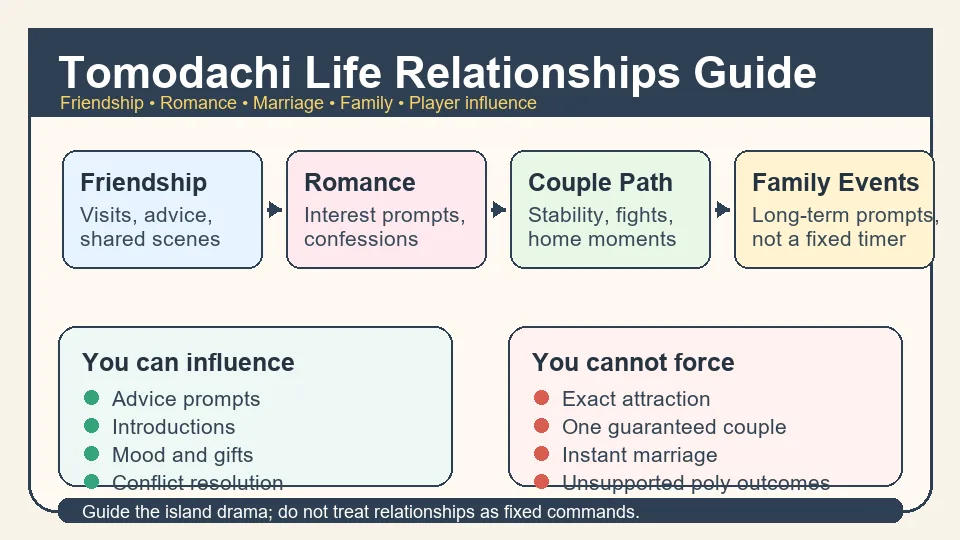
Tomodachi Life: Living the Dream treats relationships as a social simulation. Each Mii has a personality, daily mood, existing friends, possible attraction, and random event timing. The player sees the result through problem bubbles, advice questions, visits, arguments, confessions, breakups, married-life moments, and family events. That makes the system feel personal, but it also means there is no clean checklist that forces two specific Miis together on command.
The best way to play is to give the island enough social variety and then respond consistently. If two Miis already spend time together, support their requests, solve conflicts quickly, and avoid pushing both characters toward competing pairings. If two Miis never interact, create more chances by adding them to the same island routine, helping introductions, and checking their homes often. Think of yourself as an editor of island drama rather than a direct matchmaker.
Relationship area
What it means
Player control
Friendship
Miis spend time together, visit rooms, ask for help, and become more socially connected.
Medium
Romance
A Mii may show interest, ask for advice, confess feelings, or react to a rival pairing.
Low to medium
Conflict
Arguments and bad moods can interrupt a friendship or couple path until resolved.
Medium
Marriage and kids
Longer-term couple outcomes may appear after the game decides the relationship is strong enough.
Low
Breakups
Some relationships cool down or fail, especially when prompts are ignored or conflict repeats.
Low to medium
What Players Can Actually Influence
Your strongest influence comes from daily maintenance. Solve problem bubbles before shopping, answer relationship questions carefully, help Miis make introductions, give gifts that improve mood, and calm down fights as soon as they appear. These actions do not guarantee a romance, but they keep the social system active and reduce the chance that a promising connection stalls because one resident is unhappy or distracted.
The weakest influence is trying to force a single outcome while ignoring the island around it. If only two Miis exist, the game has fewer options but also fewer natural scenes. If too many residents are unhappy, romance prompts may be delayed by basic problem solving. A strong relationship strategy is therefore simple: maintain happiness, build a varied cast, watch repeated interactions, then support the pairings that the game is already surfacing.
1
Track repeated interactions
When two Miis keep visiting each other, asking about each other, or appearing in social scenes, treat that pair as a realistic relationship candidate.
2
Answer advice prompts consistently
If you want a pairing to develop, avoid contradictory choices. Encourage friendly or romantic steps when the game asks for your opinion.
3
Resolve conflict quickly
Arguments can block social momentum. Fix fights, improve mood, and check both Miis afterward so the relationship path can continue.
4
Keep other routines healthy
Food, clothes, interiors, gifts, and dream checks keep residents active. A happier island creates more chances for social prompts.
Romance, Marriage, Living Together, and Kids
Romance usually starts with a prompt: a Mii asks about another resident, wonders whether someone likes them, or wants help with a confession. The exact wording changes by situation, but the practical rule is the same. Read the prompt, decide whether you want to support that pairing, and then follow through. If the confession or date scene does not work, do not treat it as a permanent failure. The same island can produce new social chances later.
Marriage and child-related events are longer-term outcomes. They depend on the game recognizing a stable couple path, not just on the player wanting it. If a couple forms, keep both residents happy, check their home, respond to couple prompts, and avoid neglecting conflicts. If you are building a family-focused island, do not rush every prompt; stable daily support matters more than trying to trigger one scene repeatedly.
Goal
Helpful routine
Common mistake
Start a romance
Support confession or interest prompts when they appear.
Reloading or waiting for one exact script instead of playing the island.
Keep a couple stable
Check both Miis, resolve fights, and maintain happiness.
Ignoring one partner once the relationship begins.
Reach marriage
Respond to couple prompts and keep the daily loop active.
Assuming marriage can be forced immediately.
Family events
Keep the couple's household active and watch for new prompts.
Treating kids as a guaranteed timer rather than a simulation outcome.
Same-Sex Relationships, Polyamory, and Outdated 3DS Advice
A lot of search results mix Living the Dream with the older 3DS Tomodachi Life. That can be misleading because the Switch release uses more modern identity and relationship framing. When you are checking same-sex relationships, pronoun choices, or how residents express attraction, rely on the current game's profile settings and in-game prompts first. Old 3DS workarounds should not be treated as current rules.
Polyamory questions are also common, but the safest guide position is to separate confirmed in-game behavior from wish-list behavior. If the game presents romance as couple-based on your island, plan around couple paths. You can still create a cast with queer residents, complex friendships, exes, rivals, and dramatic friend groups, but do not promise a poly relationship structure unless the game itself exposes that option.
Question
Practical answer
What to avoid
Same-sex couples
Use current Living the Dream settings and prompts; the Switch game is more inclusive than the 3DS baseline.
Copying old 3DS-only limitations.
Pronouns and identity
Set each Mii carefully and check how the game uses those settings in visible prompts.
Assuming every old guide uses current wording.
Poly relationships
Treat romance as couple-based unless the game directly offers another structure.
Publishing unsupported claims from rumors or mods.
Babies and families
Watch current couple and household prompts in your own game state.
Assuming every couple path has the same timing or outcome.
Compatibility Checklist: How to Read Pairings Without Forcing Them
Many searches ask how to make two Miis fall in love, whether same-sex couples can marry, or whether a poly relationship is possible. The practical answer is to read the relationship system as a set of signals. Repeated visits, positive advice prompts, quick conflict recovery, and matching daily routines are stronger signs than one isolated confession scene. The player can support those signals, but the simulation still owns the final timing.
Use a simple checklist before you chase one pairing: both Miis should be happy, neither should be stuck in a fight, they should have chances to meet, and your advice should not keep sending them toward rival partners. For same-sex or inclusive pairings, trust the current in-game prompts and profile options over older 3DS-era advice. For polyamory searches, keep the boundary clear: unless the game explicitly presents a multi-partner structure, plan around couple-based romance and friendship networks.
Signal
What to check
Useful player action
Repeated visits
The same two Miis appear in rooms, chats, or social requests more than once.
Encourage introductions and avoid interrupting the routine with conflicting advice.
Advice prompts
A Mii asks about another resident or wants help with a confession.
Answer consistently if you want the pairing to continue.
Conflict recovery
Arguments are solved quickly and both residents return to normal moods.
Use gifts, apologies, and mood support before waiting for romance prompts.
Inclusive pairing questions
The current game UI offers profile or relationship prompts that support the pairing.
Follow the current Switch-era prompts instead of old 3DS limitations.
Poly relationship searches
Players ask about more than two romantic partners.
Treat romance as couple-based unless the game clearly shows another supported structure.
Relationship Search Questions: Levels, Romance, and Improving Mii Bonds
The most useful relationship searches are practical: Tomodachi Life relationship levels, Living the Dream romance, and how to improve Mii relationships. Keep those questions on this page because they all ask how the same social simulation moves from friendship to romance, marriage, conflict, or recovery.
Answer the levels question as a set of visible signals rather than a secret score sheet. Repeated visits, advice prompts, mood, conflict recovery, and relationship status matter more than one isolated scene. The separate Babies & Family Events Guide owns baby-event timing and household planning, so this page links there instead of duplicating that narrower intent.
Shared routines create more chances for friendship and relationship scenes, but they do not guarantee a result.
Candidate keyword
Volume / difficulty
Intent
Decision
Tomodachi Life relationship levels
Similarweb global volume 1,703; difficulty 0
Guide/table intent
Add to the relationship-signals table and explain visible stages without inventing a score.
Tomodachi Life: Living the Dream relationship levels
Global volume 2,582; difficulty 0
Release-specific variant
Use in the paragraph and FAQ wording.
How to improve Mii relationships in Tomodachi Life
Question volume 400; difficulty 0
Practical support
Answer with happiness, prompts, routines, and conflict recovery.
Tomodachi Life: Living the Dream romance
Related volume 3,261; difficulty 0
Romance support
Keep inside the romance section, not a separate dating page.
Can you have poly relationships in Tomodachi Life?
Phrase volume 165; difficulty 0
Limit/FAQ intent
Answer the current couple-based boundary without promising unsupported mechanics.
Tomodachi Life babies
Dedicated existing page
Separate family-event intent
Link to the Babies & Family Events Guide and do not duplicate its timing details.
Troubleshooting: Why a Relationship Is Not Moving
If two Miis are not getting closer, first check basic island health. Are both residents happy? Do they have unresolved fights? Are you answering prompts in ways that support the pairing? Are there enough other residents for the game to generate normal social scenes? Relationship progress often looks stuck when the island is full of unsolved problems or when the player only watches one household and ignores everyone else.
If a relationship fails, let the island breathe. Add new residents, refresh daily routines, solve problems, and wait for new prompts. A breakup or rejected confession can still create useful story material, especially if you are playing Tomodachi Life as an island diary. The strongest islands are not the ones where every plan works; they are the ones where the game creates surprising friendships, awkward crushes, and funny social consequences you can remember later.
1
Check both Miis separately
Look for mood issues, unsolved requests, food dislikes, or conflicts that may be blocking new social scenes.
2
Stop forcing one scene
Play a full daily loop instead of waiting at one door. More island activity creates more relationship prompts.
3
Use failure as story fuel
Rejected confessions, rivals, and breakups can make the island funnier and give future relationships more context.
Relationships FAQ
Can I force two Miis to fall in love?
No. You can influence chances through advice, introductions, happiness, and conflict resolution, but the game still controls attraction and timing.
Do same-sex relationships work in Living the Dream?
Living the Dream supports more inclusive relationship framing than the older 3DS game. Use current in-game settings and prompts instead of relying on outdated 3DS limitations.
Can Miis have poly relationships?
Treat romance as couple-based unless the game clearly presents another relationship structure. Polyamory search interest exists, but unsupported outcomes should not be promised.
Why did a confession fail?
A failed confession usually means the simulation did not accept that pairing at that moment. Keep both Miis happy and continue normal island routines for future chances.
How do I improve friendship between two Miis?
Help introductions, answer social prompts consistently, resolve fights quickly, and keep both residents active with gifts, food, clothes, and room visits.
Are relationship guides from the 3DS game still accurate?
Some broad habits still help, such as solving problems and watching prompts, but identity options and relationship framing can differ. Prioritize Living the Dream information.
How do I improve relationship chances without forcing a couple?
Keep both Miis happy, resolve arguments quickly, support repeated interactions, and answer advice prompts consistently. You can improve the conditions for a relationship, but the game still decides whether a confession, marriage, or family event appears.
Does Tomodachi Life: Living the Dream allow gay relationships?
Use the current game's own profile options and relationship prompts as the source of truth. This page answers the question inside the relationship system without relying on outdated 3DS assumptions.
How do I improve Mii relationships in Tomodachi Life?
Keep both Miis happy, resolve arguments quickly, support repeated interactions, and answer advice prompts consistently. These actions improve the conditions for a relationship, but the simulation still decides whether friendship, romance, marriage, or a family event appears.