GuideSwitch 1, Switch Lite, OLED, and Switch 2 decisions
Tomodachi Life: Living the Dream Switch 1 vs Switch 2 Guide
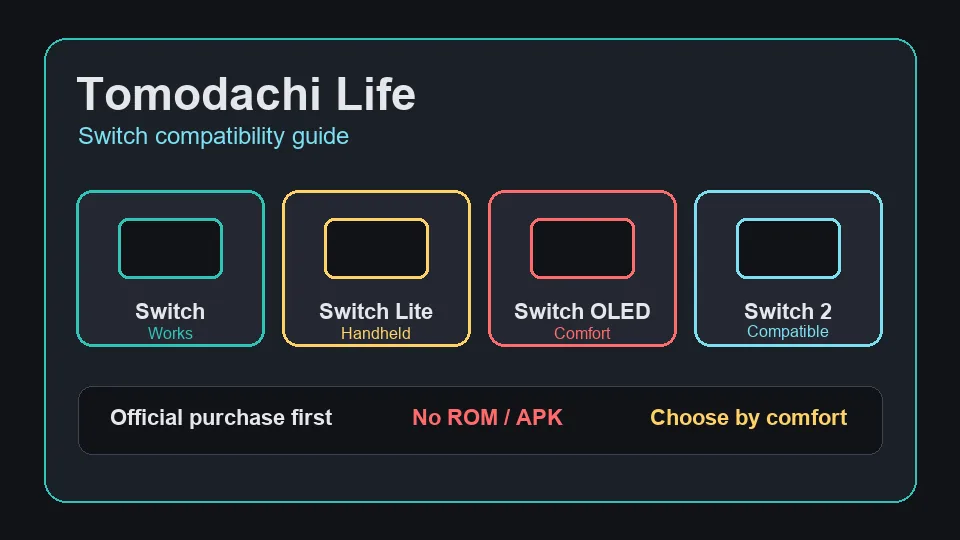
The short answer: Tomodachi Life: Living the Dream is a Nintendo Switch game, not a Switch 2-only release. Switch 2 can play it through compatibility, but most players should decide based on screen, controls, budget, and whether they already own a Switch system.
Do you need Switch 2?
No. The game is sold as a Nintendo Switch title. Switch 2 compatibility is useful, but it is not a requirement for starting your island.
Does it work on Switch 1?
Yes. Standard Nintendo Switch, Switch Lite, and OLED-style play are the practical baseline unless Nintendo lists a region-specific exception.
Which console is best?
Use the system you already own unless you want a larger display, newer hardware, or Switch 2 features for your broader game library.
Quick Answer: Switch 1 or Switch 2?
If you are asking whether Tomodachi Life: Living the Dream is for Switch 1 or Switch 2, treat it first as a Nintendo Switch release. That means a normal Switch owner can plan around the same game listing, the same official purchase path, and the same core island simulation. Switch 2 compatibility matters because many players are buying new hardware in 2026, but it does not turn the game into a separate Switch 2 edition.
The most practical decision is simple. If you already own a working Switch, buy the game for that system and start playing. If you are already moving to Switch 2 for other games, keep this title in the compatibility column. If you only play handheld, compare comfort and screen size rather than expecting exclusive Tomodachi features.
Player situation
Best choice
Why
Already owns Switch 1, Lite, or OLED
Use your current console
Replacing hardware just for this game is usually unnecessary.
Buying a console now
Choose by total library and budget
Switch 2 may be better for future games, while Switch 1 hardware can be cheaper.
Family or younger player
Prioritize official purchase and supervised profiles
Compatibility matters less than account safety and screen comfort.
Collector or long-session player
Consider OLED or Switch 2 screen comfort
Tomodachi is a daily check-in game, so readability matters.
Compatibility Matrix: Switch, Lite, OLED, and Switch 2
Tomodachi Life is built around short visits, Mii editing, menus, homes, shops, and social prompts. Those activities do not require a high-performance setup. The difference between systems is more about where you play, how the screen feels, and what controllers you prefer.
Switch Lite is fine for a personal island if you mainly play handheld. Standard Switch and OLED give you TV play and easier family sharing. Switch 2 is attractive when you want new hardware anyway, but the buying logic should include your whole Nintendo library rather than one social-sim title.
Console
Expected fit
Best for
Tradeoff
Nintendo Switch
Primary baseline
Players who already own the system
Older hardware and smaller screen than OLED or Switch 2.
Switch Lite
Good handheld option
Solo players and kids with supervised profiles
No TV mode and less flexible shared-console play.
Switch OLED
Comfortable Switch 1 option
Handheld players who value screen quality
Still not new-generation hardware.
Nintendo Switch 2
Compatible path
Players upgrading for a wider 2026 library
Do not buy only for unconfirmed exclusive Tomodachi benefits.
What Switch 2 Changes and What It Does Not
Switch 2 compatibility can make the purchase feel future-proof, but compatibility is not the same thing as a separate enhanced edition. Unless Nintendo describes a specific feature for this game in your region, assume the core loop remains the same: create Miis, solve problems, check relationships, visit dreams, and return for daily surprises.
Some players search for Handheld Mode Boost or mouse controls because those terms appear around Switch 2 compatibility in general. Treat them as console-level or compatibility notes, not as a promise that Tomodachi Life becomes a different game. If a feature changes menus or comfort, it is useful; if a rumor promises exclusive systems, wait for official wording.
1
Check the official store listing
Use the current Nintendo product page for platform, price, language, and compatibility notes before buying.
2
Separate hardware features from game features
A console-level feature does not automatically mean new island mechanics, relationships, or Mii limits.
3
Ignore region-mismatched claims
Store pages and support pages can vary by country, so confirm the listing for the account region you will use.
Buying Checklist: Price, Digital, Physical, and Family Play
Before buying, confirm four things: the official product page, your account region, storage space, and which console profile will own the game. Digital copies are convenient for daily check-ins, while physical copies can be easier for families who share cartridges. Either route should still come from Nintendo or trusted retailers.
For families, decide whose island is the main island before purchase. A younger player may need supervised account settings, and a shared household Switch may need clear rules about save access. Tomodachi Life feels lighthearted, but it still uses names, likenesses, relationships, and personal jokes, so privacy and account safety matter.
1
Confirm platform and region
Open the official Nintendo listing while signed into the correct region or country storefront.
2
Choose digital or physical
Digital is convenient for daily sessions; physical can be simpler when multiple people share hardware.
3
Plan save ownership
Pick the user profile that will own the island before a child or family member starts creating Miis.
4
Bookmark safe guides
Use fan guides for mechanics, but use official stores for purchases and support.
Price and Switch 1 Questions to Answer Before Buying
Searchers often pair compatibility with price: how much is Tomodachi Life on Switch, does it work on Switch 1, and whether Switch 2 changes the value. The safe answer is to check the current Nintendo product page or trusted retailer in your region because price, tax, preorder bonuses, and stock can change.
Do not use price searches as a doorway to free-download pages. If the official price is too high, wait for a sale, compare physical retailers, or use wish-list alerts. The compatibility decision should stay separate from unsafe ROM, APK, and emulator claims.
Question keyword
Similarweb signal
Page action
tomodachi life switch
Traffic 19k, difficulty 16
Keep as supporting phrase in intro and related anchors.
nintendo switch tomodachi life
Traffic 4.8k, difficulty 13
Use in compatibility matrix and metadata.
is tomodachi life on switch 1
Traffic 1.9k, difficulty 20
Answer directly in FAQ and quick answer.
how much is tomodachi life on switch
Question traffic 1.1k, difficulty 14
Add price FAQ; do not quote unstable prices.
tomodachi life switch 2
Traffic 4.2k, difficulty 16
Keep in Switch 2 notes, not a new page.
Avoid ROM, Emulator, APK, and Free Download Searches
Search demand around free downloads, ROMs, emulators, and APKs often spikes after a popular Switch release. This site does not provide or recommend those paths. Tomodachi Life: Living the Dream is a paid Nintendo Switch game, and unofficial downloads can create malware risk, broken saves, account problems, or copyright issues.
If your real question is access, the safer answer is to compare console options, wait for a sale, use local retailers, or check official digital availability. If your real question is whether the game is worth buying, read guide pages, watch official footage, and decide whether daily Mii simulation is the loop you want.
Search claim
Risk
Safer answer
Free Switch download
Often piracy or malware bait
Use official Nintendo store or trusted retailers.
APK for Android
Not the Switch game
There is no safe fan-site APK path for this paid Nintendo title.
ROM or emulator save
Can break support and expose files
Use official hardware and manual Mii templates.
Switch 2 exclusive leak
May be rumor or region confusion
Wait for Nintendo product or support text.
Official footage to watch before buying
Use official Nintendo footage as a reality check for the tone, Mii creation, island scenes, and daily rhythm before you decide whether the game fits your Switch setup.
Switch Compatibility FAQ
Is Tomodachi Life: Living the Dream on Switch 1 or Switch 2?
It is a Nintendo Switch title with Switch 2 compatibility. Treat Switch 1, Lite, and OLED as the normal baseline unless your regional store page says otherwise.
Do I need Nintendo Switch 2 to play it?
No. Do not buy Switch 2 only because of this game unless you also want the newer hardware for other games or long-term library support.
Does Switch 2 have a special Tomodachi Life version?
Use official Nintendo wording for your region. Compatibility does not automatically mean a separate enhanced edition or exclusive island mechanics.
Can I play on Switch Lite?
Switch Lite is a practical handheld choice for a solo island. The main tradeoff is the lack of TV mode and less flexible shared-console play.
Is digital or physical better?
Digital is convenient for daily check-ins. Physical can be easier for families who share cartridges or prefer collection options.
Are free downloads, ROMs, or APKs safe?
No. Use official purchase paths. This fan wiki does not link to ROMs, emulator builds, cracked files, or APK downloads.
How much is Tomodachi Life on Switch?
Check the current Nintendo product page or a trusted retailer in your region. Price, tax, promotions, and stock can change, so this guide avoids quoting a fixed price.